
 EN
EN
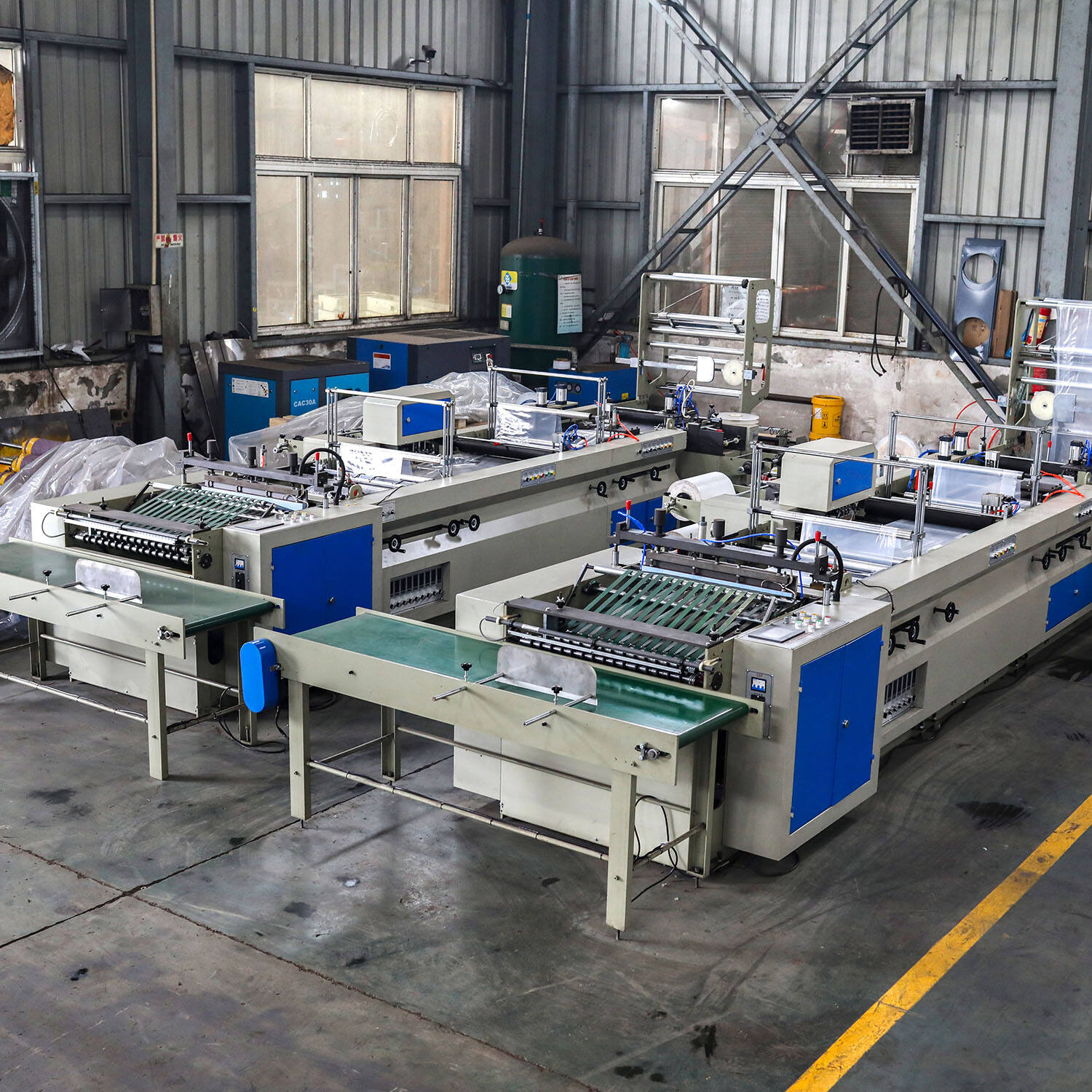
Core Components of a Plastic Bag Making Machine for Foldable Output
Integrated workflow: Synchronizing film unwinding, folding, sealing, and cutting
Today's plastic bag manufacturing equipment creates those neat foldable designs through a carefully timed process. It all starts when the machine unwinds the plastic film using servos that keep everything aligned within about 0.15mm tolerance, which stops those annoying asymmetrical folds from happening. The film keeps moving along until folding arms come into play, pressing creases right into the material with special cam shapes that were actually patented for this exact purpose. These folding mechanisms work so well that nobody needs to manually adjust anything during production. At the same time, there are these heat sealing jaws working away at temperatures between 200 and 220 degrees Celsius, forming those side seams in just half a second per cycle. Meanwhile, sharp rotary blades slice through the material cleanly as it goes. What makes this whole system really impressive is how it skips those old fashioned waiting periods where bags had to sit around for days before they could be folded properly. Now manufacturers can produce fully foldable bags straight off the line without any delays.
Key subsystems: Heat-sealing station, precision folding cam system, and servo-driven cut-and-stack unit
Three engineered subsystems ensure reliable fold formation:
- Heat-sealing stations utilize PID-controlled ceramic heaters that maintain ±3°C uniformity, preventing delamination failures which increase by 18% per 10°C deviation (ASTM F2054-22)
- Folding cam systems employ hardened-steel profiles with error-compensating linkages to maintain <0.2mm positional repeatability
- Servo-driven cut-and-stack units synchronize bag separation with stacking arms, enabling speeds over 200 bags/minute while preserving fold integrity
Balancing speed and fold integrity: Addressing cam timing drift in high-speed production
When production hits over 150 bags per minute, harmonic vibrations start causing problems with cam timing. These issues lead to about 12% more fold defects for every additional 15 meters per minute of speed. The best machines on the market now come equipped with optical sensors that spot when folds go off track. These sensors then send signals to make tiny adjustments to the cam positioning through what's called closed loop servo control systems. What this means in practice is that fold accuracy stays within roughly half a millimeter even at top speeds. No need for workers to constantly stop the line and tweak things manually anymore, which cuts down on those frustrating production halts we all hate.
From Plastic Film to Fold-Ready Bags: The Manufacturing Process Flow
Extrusion and film formation: How HDPE/LDPE/LLDPE melt flow affects foldability
Extrusion begins when polymer pellets are heated to around 200 to 300 degrees Celsius. At this stage, the melt flow index or MFI plays a big role in how well materials can be folded later on. High density polyethylene has quite a bit of crystallinity, usually between 60% and 80%, which makes the final film pretty stiff. Manufacturers need to watch temperature closely here because if things get too hot or cold, those HDPE films tend to develop brittle folds. Low density polyethylene works differently thanks to its branched chain structure. These materials generally have lower resistance to folding, especially when their MFI ranges from 0.3 to 6 grams per 10 minutes. Linear low density polyethylene strikes a nice middle ground though. Its straight chain molecules give good puncture resistance while still maintaining consistent fold memory properties, which is why many companies prefer LLDPE for making reusable shopping bags. When temperatures during extrusion vary more than plus or minus 5 degrees Celsius, problems start showing up. The molecules don't align properly across the material, leading to irregular fold lines that can crack under stress during fast production runs.
Slitting precision: Maintaining ±0.15 mm tolerance for accurate bag forming
Post-extrusion, slitting accuracy determines downstream folding performance. Servo-controlled blades with laser-guided positioning achieve ±0.15mm tolerance, preventing edge misalignment that leads to sealing failures. At speeds over 200 m/min, exceeding this tolerance results in:
| Tolerance Breach | Consequence | Failure Rate Increase |
|---|---|---|
| +0.25 mm | Gusset misalignment | 12–18% |
| -0.20 mm | Film tension imbalance | 8–15% |
This precision ensures uniform bag dimensions, critical for automated stacking—where even 0.1mm variance accumulates to a 5cm offset per 500 bags.
Advanced Folding Mechanisms for Collapsible and Gusseted Bag Designs
Multi-fold, accordion, and concertina patterns: Trade-offs in pack density and shelf stability
Collapsible designs made possible by precision folding systems really help with storage space and how products look on store shelves. When it comes to multi-fold patterns, they do great job compressing bags vertically so more can fit on each pallet. But there's a catch - those same designs might not stand up well on their own if the gussets aren't lined up just right. Then we have accordion folds with those zig zag side panels that pack things down even tighter. However, getting these right takes serious attention to tension control during production runs, otherwise the whole thing tends to buckle when running at speed. For products meant to sit nicely on retail displays, concertina folds win hands down because of their rigid structure from those interlocking pleats. Getting this right means investing in servo controlled fold plates that need to be accurate within half a millimeter either way to avoid stacking problems. According to industry data, concertina designs give around 40% better stability on shelves compared to regular single fold options, though they take up about 15 to 20% more space per unit. The trick for manufacturers is finding the sweet spot between these factors while adjusting folding mechanisms according to variations in film thickness across different batches.
Precision Heat Sealing: Aligning Temperature, Speed, and Fold Accuracy
Impact of sealing temperature variance: 10°C deviation and its effect on delamination (ASTM F2054-22)
Getting the temperature just right matters a lot when it comes to heat sealing. If there's even a 10 degree difference from what's needed, layers start to separate from each other which weakens the whole package structure. Tests according to ASTM F2054-22 standards have actually found these kinds of temperature fluctuations cut down seal strength somewhere between 30% and 40%. That means more failures happen especially with those types of packaging that collapse or fold. The science behind it involves polymer chains needing exactly the right amount of heat energy so they can properly tangle together. Not enough heat leads to poor bonding between materials, but too much heat actually breaks down the material itself. Today's equipment typically includes temperature sensors that keep things within about 2 degrees either way, and these systems work hand in hand with how fast the conveyor belt moves to ensure proper folding. When manufacturers don't have this kind of temperature control, problems show up particularly with gusseted bags where seals tend to fail when pressure is applied during storage on shelves. This kind of failure definitely impacts how stable products remain while sitting on retail displays.
Temperature Deviation Consequences
| Variance | Seal Strength Loss | Delamination Risk |
|---|---|---|
| ±5°C | 10–15% | Moderate |
| ±10°C | 30–40% | High |
| Data derived from ASTM F2054-22 accelerated aging tests |
Regular calibration prevents hotspot development—unmonitored heating elements can exceed 15°C variance within months. The standard mandates validation through peel testing at controlled deviations, confirming optimal performance within narrow thermal bands (typically 120–180°C, depending on polymer). This ensures foldable bags withstand compression forces without seal failure.
FAQ
What are the key components of a plastic bag making machine for foldable output?
The key components include an integrated workflow system that synchronizes film unwinding, folding, sealing, and cutting, as well as key subsystems like the heat-sealing station, precision folding cam system, and a servo-driven cut-and-stack unit.
How does sealing temperature affect the quality of plastic bags?
Sealing temperature significantly affects the quality of plastic bags. A deviation of 10°C from the optimal temperature can decrease seal strength by 30% to 40%, leading to higher risks of delamination and packaging failure.
Why is slitting precision important in bag manufacturing?
Slitting precision is crucial because it ensures uniform bag dimensions necessary for efficient automated stacking and minimizes edge misalignment, which can lead to sealing failures.
How do different folding patterns impact the usability of plastic bags?
Different folding patterns, such as multi-fold, accordion, and concertina, offer trade-offs between pack density and shelf stability. These patterns affect storage space efficiency and how well products display on shelves.
What types of polymers are used in making foldable plastic bags?
High-density polyethylene (HDPE), low-density polyethylene (LDPE), and linear low-density polyethylene (LLDPE) are commonly used. Each type has unique properties that impact foldability, strength, and puncture resistance.